The problem
AI coding agents — Cursor, v0, Bolt — are probabilistic. They guess at styles and omit accessibility, leading to real technical and legal debt. The root issue is that design systems are built for humans: unless one is published as an installable package, an AI agent can't consume it directly. And even when an agent does generate UI, it typically doesn't check contrast or add accessibility labels, so the output may not be accessible at all.
There's also a context-window problem: the visual styling instructions given in message #1 of a chat are often exactly what gets pushed out of context first, as the conversation goes on.
The solution
VibeMagic is a deterministic framework that converts a design system into a "skill" file — an instructions.md that sits in your project folder and gets referred to every time the AI tries to create a UI component. It forces 100% compliant rules regardless of context window limits, bringing your own design system into your vibe-coding workflow instead of leaving styling to chance.
How it works
Start with a template, an image, or a website URL
Pick a starting point — a curated design system template, a UI screenshot the agent analyses to extract colors, or a live website (screenshots are used to extract brand colors).
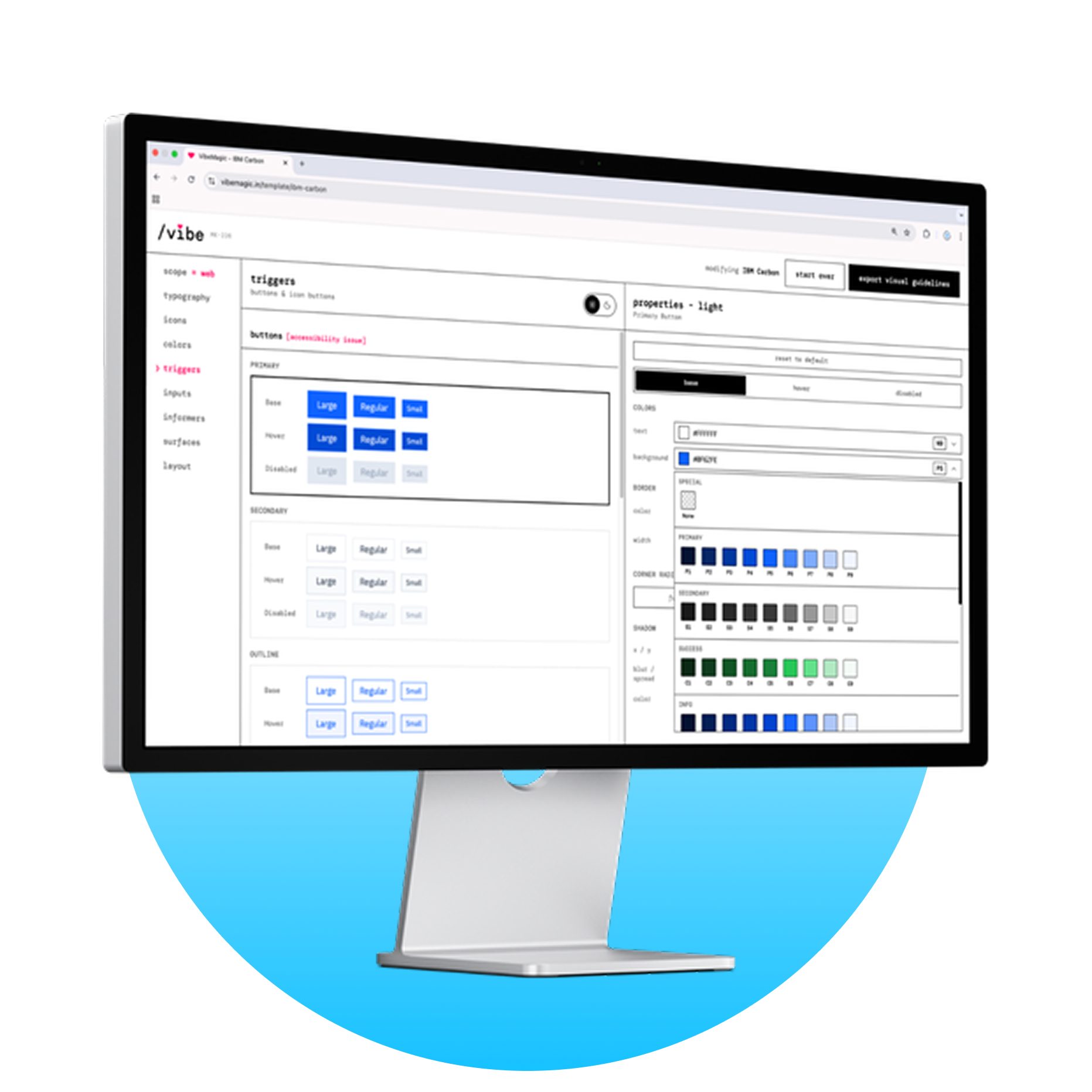
Adjust properties in a visual config
Review the extracted colors and styles and edit them however you like, with contrast issues flagged as you go.
Get the instruction file
Download it for mobile apps, web, or a combined version.
Give the file to your coding agent
Drop it into your project folder and ask your agent (Cursor, v0, Bolt, or similar) to refer to it while creating any component.
Accessibility, not an afterthought
- The instruction file has strict, non-negotiable rules requiring name-role-value-state labels on every interactive component it generates, including semantic meaning for icons
- It won't let the agent build a non-regulation-sized interactive element
- Contrast issues are highlighted immediately while building the design system visually, in both light and auto-generated dark mode
- Dark-mode tokens can be auto-generated from your light-mode colors without manual mapping
- Every generated rule is editable by design system experts — it's a starting point enforced by default, not a black box
The benefits
40%
reduction in front-end debugging time
30%
reduction in credit consumption for minor UI fixes
100%
consistency, enforced by the instruction file
30%
reduction in accessibility issues
Templates and imports
No design system yet? Start from a curated template — Atlassian ADS, Salesforce Lightning, Google Material M3, IBM Carbon, GitHub Primer, Ant Design, Bootstrap 5, Shopify Polaris, Twilio Paste, Microsoft Fluent, or GitLab Pajamas. Direct import from an existing Storybook or Zeroheight design system is in progress.